
Is Trenchless Sewer Repair Better Than Digging?
Santa Clarita Sewer Repair compares trenchless lining, pipe bursting and open-trench replacement for sewer laterals in Santa Clarita Valley yards — what each method needs from the old pipe, what it does to the yard, where each one stops working, and why the camera inspection makes the decision.
Bookings aren't open yet. Leave your name and number; your message is recorded, and you'll get one message when a local installer is available.
The line as it is found
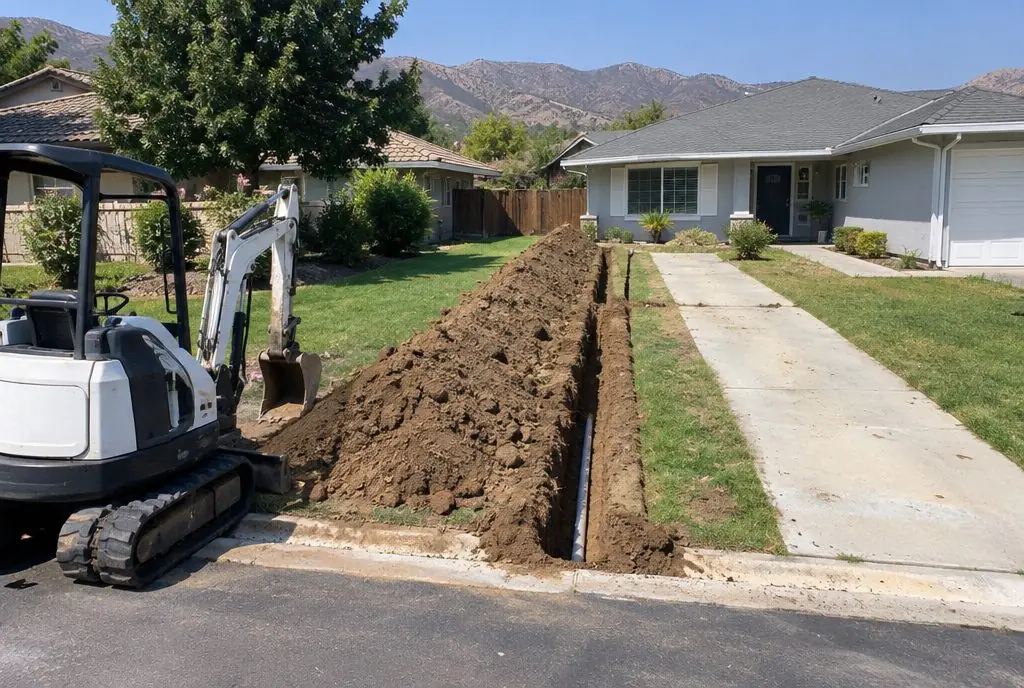 Illustration
The repaired line (illustration)
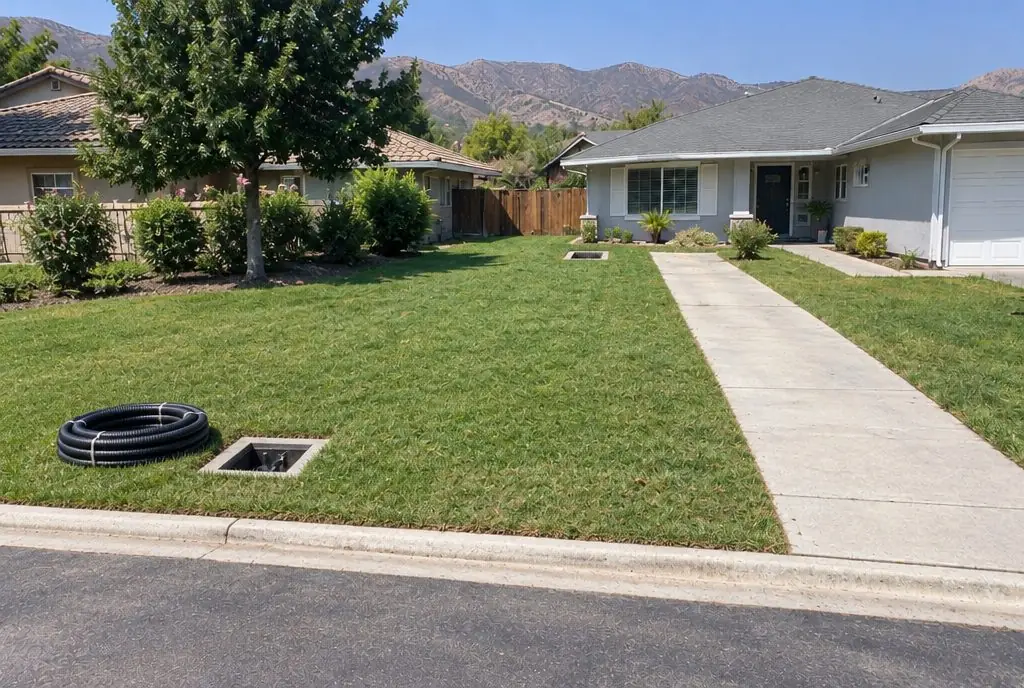 Illustration
Better for many yards, not for every pipe
Trenchless lining and pipe bursting avoid a long open trench in many yards, but not all: a collapsed pipe, a deep sag (belly), a badly offset joint or a line under a structure can rule them out. A camera inspection decides which methods are possible. Where the pipe qualifies, trenchless work usually means less disturbance to driveways, landscaping and trees; where it does not, open trench is the method that actually fixes the line.
The camera decides which methods are possible; the yard decides which of those makes the most sense.
What each method needs and what it leaves behind
| Method | Needs from the old pipe | Digging involved | Main limits |
|---|---|---|---|
| Lining (cured-in-place pipe) | round, passable, clean after jetting | usually none or one small access pit | follows sags; cannot pass a collapse; reduces inside diameter slightly |
| Pipe bursting | continuous path for the cable | an entry pit and an exit pit | follows the old path; needs room for pits; can disturb nearby utilities |
| Open trench | nothing; the old pipe is removed | a trench along the whole route | surface restoration; cost rises fast under hardscape and at depth |
Lining: a new pipe inside the old one
Lining saturates a felt tube with resin, inverts it into the cleaned pipe with air or water pressure, and cures it into a continuous new pipe with no joints. It suits clay or plastic laterals that are still round and on grade but have cracks or root-filled joints. Branch connections inside the run are reopened from inside after curing. Lining reduces the pipe's inside diameter slightly, which is acceptable for most residential laterals in sound shape.
Pipe bursting: replacing the pipe along the same path
Pipe bursting pulls a cone-shaped head through the old pipe on a cable, breaking it outward into the soil, while new HDPE pipe follows behind. It needs a continuous path for the cable and two pits, and it suits laterals under driveways or deep laterals where a long trench would be expensive. The new pipe follows the old route, so it does not correct a sag along the way.
Open trench: still the right answer for some lines
Open trench removes the old pipe and lays new pipe on compacted bedding, which is the only method that corrects grade along the whole run. It is often the most direct answer on a lawn route with no hardscape, and it is the answer for a collapsed Orangeburg line, a badly offset joint or a sag. On the hillside lots of Canyon Country, where laterals can run deep, trenching costs rise quickly, which is when trenchless methods earn their place.
How the method changes the estimate
Each method has its own per-foot range in the estimator on this page, and the site conditions — hardscape over the route and depth — add to it. Choosing the method in the estimator shows how the typical Santa Clarita Valley range changes for the same length of lateral, and the camera inspection then narrows the choice to the methods the pipe allows.
Where this leads
- Service page: Trenchless Sewer Lining (CIPP) — A resin liner cured inside the old pipe: a new jointless pipe without digging, for laterals that still hold their shape.
- Local page: Sewer line repair in Canyon Country
- All services and typical prices: sewer line repair in Santa Clarita
- More illustrated guides: Sewer Line Guides
Check availability and the price range for this setup
Bookings aren't open yet — describe the sewer line and you get a Santa Clarita price range right here. Typical Santa Clarita Valley installed prices for residential sewer lateral work, labor and materials. This is a market estimate, not a quote. Permit fees, inspection fees and street restoration charges, where they apply, are not included.