
How Do You Know if Tree Roots Are in Your Sewer Line?
Santa Clarita Sewer Repair explains how root intrusion in a sewer lateral shows itself in Santa Clarita Valley homes — the drain symptoms, the clues in the yard, why roots get in at the joints of older pipe, how a camera confirms it, and what clearing roots does and does not fix.
Bookings aren't open yet. Leave your name and number; your message is recorded, and you'll get one message when a local installer is available.
The line as it is found
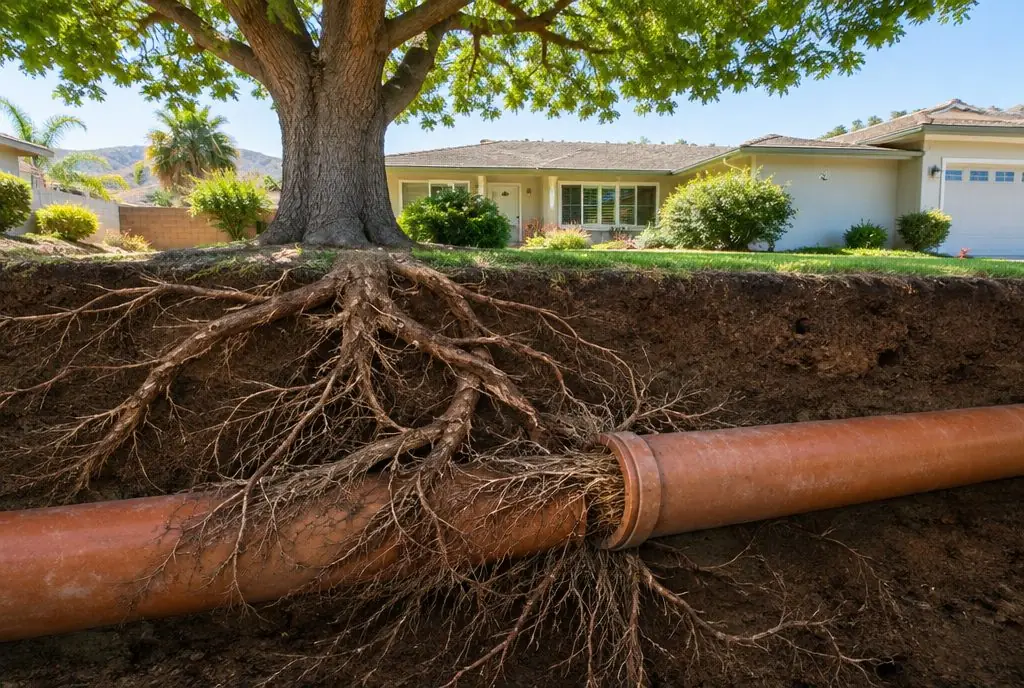 Illustration
The repaired line (illustration)
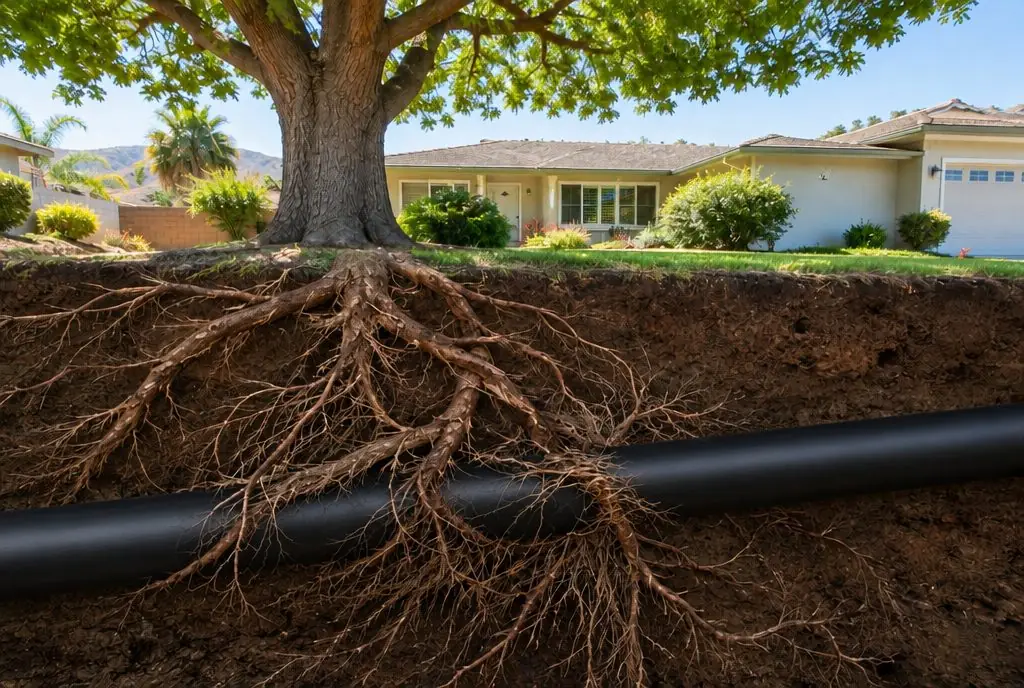 Illustration
The signs that point to roots
Roots in a sewer lateral rarely announce themselves all at once. The usual pattern is a slow decline: drains that empty more slowly every few months, a toilet that gurgles when the washing machine drains, and blockages that come back after being cleared. Older Saugus ranch homes, with clay laterals and mature trees in the front yard, see this pattern often.
| Sign | What it usually means | Next step |
|---|---|---|
| Several drains slow at once | a restriction in the lateral, not one fixture | camera inspection of the lateral |
| Gurgling when other fixtures drain | air pushed through a partly blocked line | camera inspection |
| Blockages that return after clearing | roots growing back through a joint | camera, then repair options |
| A lush green strip over the line in a dry yard | water and nutrients leaking from the pipe | camera to locate the leak |
| A sewer smell in the yard | a crack or open joint near the surface | camera and repair |
Why roots get into older pipe
Clay sewer pipe was laid in short sections, and on older laterals the joints were sealed with mortar or similar material that cracks over time. A hairline gap at a joint releases warm, moist air and a little water, and tree roots grow toward it. Once a root tip gets in, it branches inside the pipe into a mat that catches paper and solids. Orangeburg and cracked cast iron let roots in the same way. Newer glued PVC and fused HDPE have far fewer openings.
Roots do not break a sound pipe; they find the weak joints that are already there.
How a camera confirms roots
A push camera fed through a cleanout shows the inside of the lateral on a screen and records it. Roots appear as fine hair-like strands or dense mats at the joints. A small transmitter in the camera head lets the location and depth of each root point be marked from the surface. The video also shows what lies behind the roots: a cracked section, an offset joint or a sag, which is what decides the repair.
Clearing roots versus repairing the pipe
Hydro jetting and root cutting clear a line; they do not repair cracked or broken pipe, and roots usually return. Clearing restores flow and lets the camera see the pipe clearly. A lasting fix removes the openings the roots use: a liner that turns the run into one jointless pipe, pipe bursting that replaces it with fused HDPE, or a trench and new pipe.
What root problems typically cost to address
The estimator on this page lists hydro jetting and root cutting and the camera inspection as separate items, alongside the per-foot methods for repair or replacement. Comparing a single cleaning with a lining or bursting range for the same lateral shows the trade-off between clearing the line now and removing the joints the roots come through.
Where this leads
- Service page: Hydro Jetting & Root Removal — High-pressure water and root cutters clear the lateral, and a camera run shows what the roots were hiding.
- Local page: Sewer line repair in Saugus
- All services and typical prices: sewer line repair in Santa Clarita
- More illustrated guides: Sewer Line Guides
Check availability and the price range for this setup
Bookings aren't open yet — describe the sewer line and you get a Santa Clarita price range right here. Typical Santa Clarita Valley installed prices for residential sewer lateral work, labor and materials. This is a market estimate, not a quote. Permit fees, inspection fees and street restoration charges, where they apply, are not included.