
Santa Clarita Sewer Repair: Project example: a spot repair that re-beds a sagging section of ABS sewer lateral under a Valencia lawn — what it involves and what it costs
Santa Clarita Sewer Repair sets out a typical spot repair for a two-story Valencia tract home: an ABS plastic sewer lateral that is sound along most of its length but has a sag in one section under the side-yard lawn, where water stands and paper collects, fixed by digging up that one section and re-bedding it on the correct slope.
Bookings aren't open yet. Leave your name and number; your message is recorded, and you'll get one message when a local installer is available.
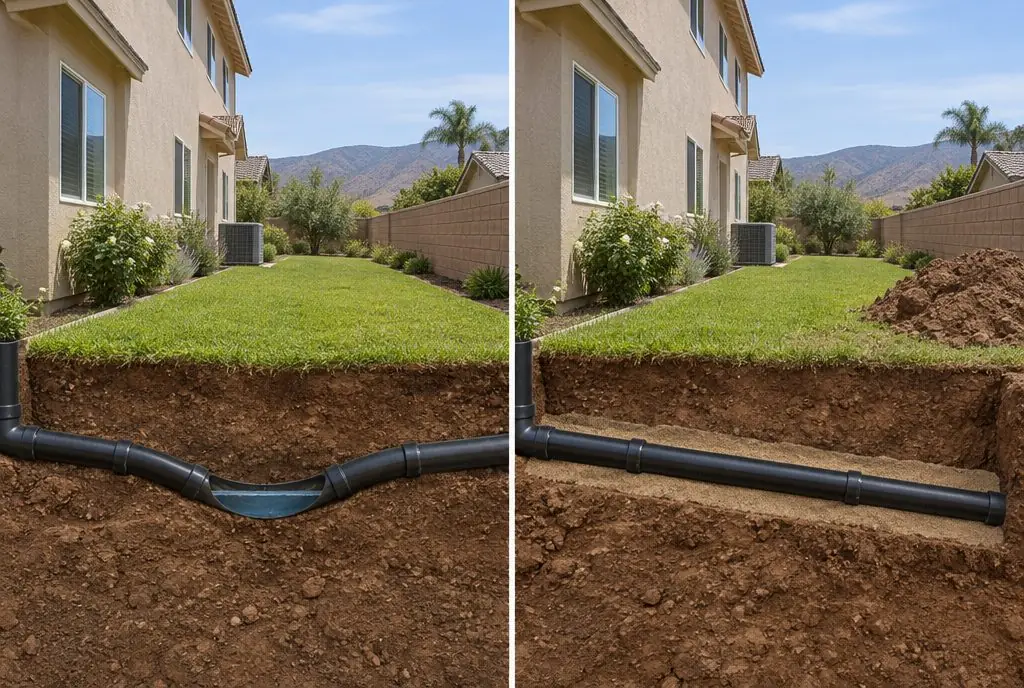
Worked example. The pictures are AI concept illustrations, not photographs; no installation was performed or arranged through this site; prices are typical Santa Clarita Valley market ranges, not quotes.
 Illustration
Starting pointFinished layout (concept)
Illustration
Starting pointFinished layout (concept)
Project Examples & Typical Prices
The scenario
The house is a two-story tract home from one of Valencia's planned neighborhoods built in the 1980s, with a sewer lateral of black ABS plastic pipe running from the side of the house, under a strip of lawn and out to the street. ABS was the common choice for laterals in the valley's tracts of that era. The pipe itself is in good condition, but the household notices that the downstairs toilet sometimes gurgles and drains slowly after laundry days.
A camera inspection explains it. About halfway along the run, under the side-yard lawn, the pipe dips in a shallow sag for several feet before rising again. Water stands in the low spot even when nothing is draining, and toilet paper collects at its downstream end. The pipe is not cracked or crushed; the soil under that section has settled, most likely because the original bedding was not compacted evenly, and the pipe has followed the soil down.
The inspection findings at a glance:
- Pipe: ABS plastic, round and uncracked along the run
- Defect: a sag of several feet in one section, holding standing water
- Effect: paper and solids collect at the low spot, slowing drainage
- Location: under the side-yard lawn, at standard depth
- Rest of the line: steady slope from the house to the street
What the job involves
- The lateral is scoped with a push camera, and the start and end of the standing water are located from the surface with a sonde and a locator and marked on the lawn, along with the depth at each point.
- Underground utilities and sprinkler lines are marked, the sod over the section is cut and rolled back, and a short trench is dug to expose the sagging pipe.
- The sagging section is cut out, the soil below it is dug out to firm ground, and a layer of sand or fine gravel bedding is placed and compacted to the correct grade.
- New ABS or PVC pipe is fitted into the gap with shielded couplings at each end, laid on the bedding so the slope runs evenly downhill, and checked with a level along its length.
- The section is bedded around the sides, covered with a layer of fine material, and backfilled and compacted in layers so the soil does not settle again.
- The whole line is scoped again to confirm the water no longer stands, the sod is laid back over the trench, and the video is left with the household.
Hardware and materials
- Replacement section of ABS or PVC sewer pipe, cut to length
- Two shielded couplings rated for joining the new section to the existing pipe
- Sand or fine gravel bedding, compacted under and around the pipe
- Pipe level and grade checks along the repaired section
- Push camera with a sonde and a surface locator
- Hand tools and a small excavator or trenching shovels, depending on access
What it typically costs in the Santa Clarita Valley
| Camera inspection with video | +$150–$400 |
| Spot repair of one section | +$1,500–$4,000 |
| Typical total | $1,650–$4,400 (market range, not a quote) |
These are typical local ranges, not a quote or an offer; an installer prices the actual job after seeing the wall.
Add-ons often paired with this job
- New two-way cleanout — +$800–$2,000. If the house has no accessible cleanout, adding a two-way cleanout during the repair makes future inspections simpler.
- Hydro jetting and root cutting — +$400–$800. Clearing the collected paper and scale from the rest of the line after the repair restores full flow.
- Camera inspection with video — +$150–$400. A follow-up camera inspection after a season confirms the repaired section has stayed on grade.
Why it is done this way
A spot repair is the right answer because only one section is at fault. The rest of the lateral is sound plastic on a steady slope, so replacing the whole line would spend most of the money on pipe that has years of service left. Lining would not help either: a liner follows the old pipe, sag and all, so the water would still stand in the low spot.
The repair focuses on the soil rather than the pipe. The sag came from bedding that settled, so the key step is digging below the sag to firm ground and building the bed back up in compacted layers. A new pipe laid on the same loose soil would sag again.
What would change the price
- The sag is longer than the camera suggested — a longer trench and more pipe are needed.
- The section is under a concrete walkway or patio — cutting and replacing the hardscape adds to the job.
- The camera finds a second defect elsewhere on the line — a second spot repair or a different method may make more sense.
- The pipe is deeper than expected — a deeper trench may need shoring.
- Sprinkler lines cross the trench — repairing them is a separate item.
Where this leads
- Service page: Sewer Line Spot Repair — One small dig at the located break or offset, one section replaced, slope checked and the line re-filmed.
- Local page: Sewer line repair in Valencia
- All services and typical prices: sewer line repair in Santa Clarita
- More worked examples: Project Examples & Typical Prices
Check availability and the price range for this setup
Bookings aren't open yet — describe the sewer line and you get a Santa Clarita price range right here. Typical Santa Clarita Valley installed prices for residential sewer lateral work, labor and materials. This is a market estimate, not a quote. Permit fees, inspection fees and street restoration charges, where they apply, are not included.